


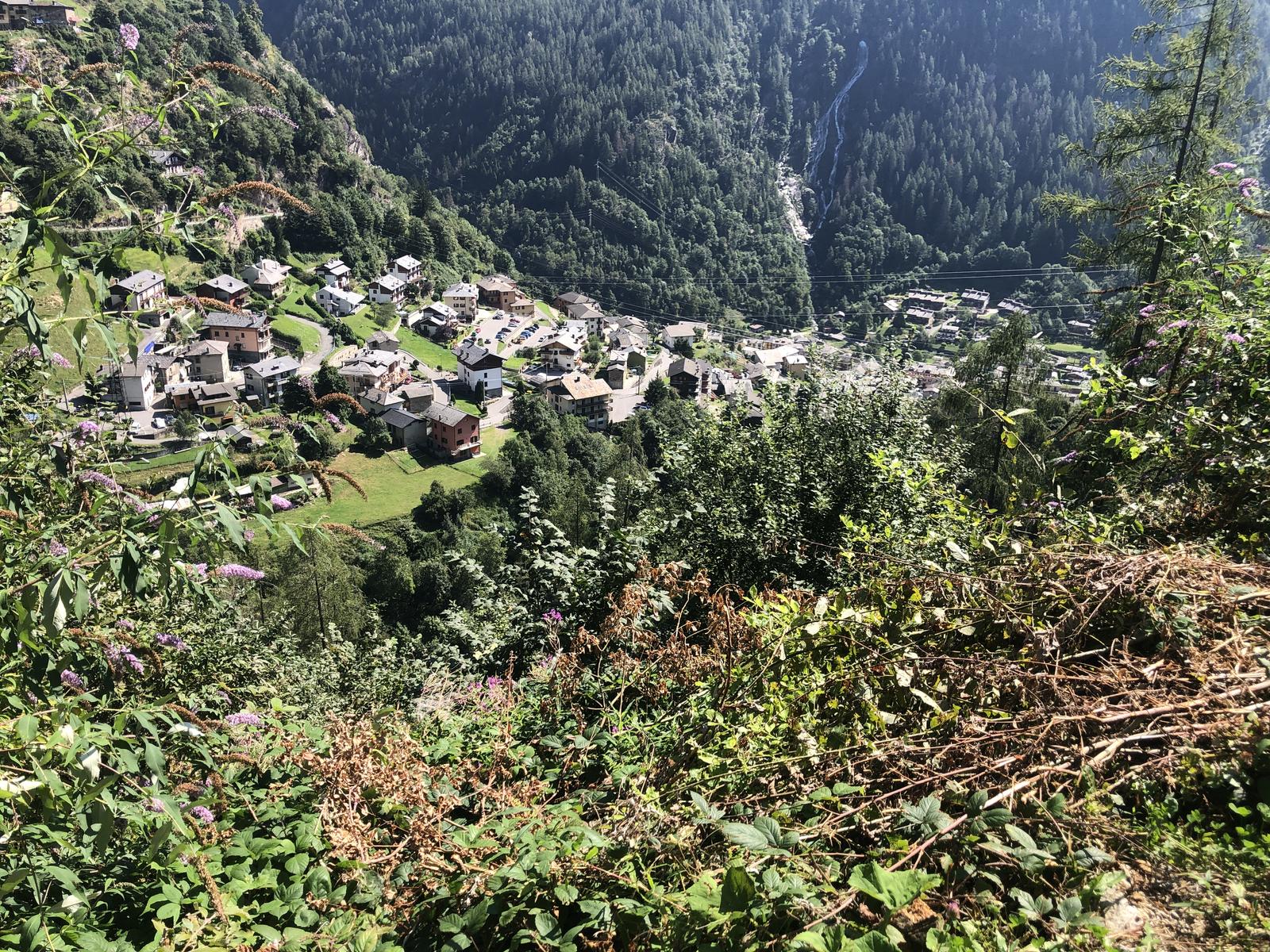
Located to the east of the town center, this stunning waterfall cascades in dramatic drops before merging with the Brembo River, with a total height difference of about 250 meters. During local festivals and patronal celebrations, the waterfall is illuminated, creating a magical and atmospheric scene that draws visitors and tourists. It’s an unmissable experience for those who want to admire the village’s beauty even at night.

The majestic Borleggia Waterfall, also known as the Branzi Waterfall, offers a natural spectacle of extraordinary power.
With a drop of 250 meters, the water crashes down fiercely through dense vegetation, breaking against large dark rocks. The roar is deafening, and the mist from the spray reaches even the nearby houses.
The ideal spot to admire its full grandeur is a small old bridge that crosses the stream at the base of the falls. From here, you can set up a tripod and photograph the entire drop without any visual interference from buildings or homes.

The current bridge, designed by engineer Calvi Natale, replaced the original wooden one, which was destroyed by a flood of the Brembo River in September 1888.
This bridge was fully restored and secured in 1998 by the company Curti Gianluigi. The project, however, pays homage to the original structure, notable for its innovative use of concrete—a significant novelty at the time. The bridge stands out for its elegance, reminiscent in miniature of the great bridges of major European and American cities, renowned in that era for their bold engineering.
The geographical location of Branzi required constant monitoring of the bridges that allowed the crossing of the two branches of the Brembo River. In 1678, following the need to restore the bridge over the Brembo River from Valleve, the town council decided to take action. On August 19, 1679, construction work began on a new stone bridge over the Liffa River.
This bridge, which likely dated back to a time before the roads to Valleve and Carona were built, provided access to the trail leading to Valleve, Foppolo, and ultimately to Valtellina.

The Church of San Sebastiano, located on Via Cagnoli, is likely the oldest surviving example of religious architecture in Branzi, probably dating back to the late 15th century. Its structure resembles that of the original Chapel of San Rocco
before the 18th-century modifications: the exterior oratory is simple and undecorated.
Inside, on the back wall, there is a 1631 fresco depicting a woman with a child wearing a coral necklace, flanked by Saints Sebastian and Roch.

This small church, preceded by a cobblestone-paved churchyard, features a façade with a central stone portal, flanked by two stone-framed windows with iron grilles. Above them are images of Saints Joseph and Bartholomew, set within
shell-decorated niches.
Above the entrance, a third window lights the nave, topped by a fresco of the Madonna and Child resting on a cloud.
The interior consists of a single rectangular nave, with smooth walls interrupted by a cornice running along the perimeter. The barrel-vaulted ceiling is joined by side lunettes.
The raised presbytery, one step higher than the nave, is narrower and covered by a vaulted ceiling with two lunettes; a semicircular window is inset into the right lunette. A scroll on the arch bears the inscription “Sancta Maria succurre
miseris” – “Holy Mary, help the afflicted.”

Located in the historic village of Belfiore, the church features a south-facing façade marked by two elegant horizontal
stone stringcourses and topped with a triangular pediment. The entrance, centered on the façade, is framed in stone
and flanked by two windows, also stone-framed and protected by iron grilles.
Above the portal is a third window, aligned with the entrance, which provides light to the nave. The interior consists of
a single nave covered by low barrel vaults, with smooth walls ending in a non-functional cornice.
The presbytery, raised three steps above the nave floor, is framed by pilasters supporting the triumphal arch. A door on
the right wall leads to the sacristy. On the left side of the building stands a small bell tower, accessible only from
outside.

The origins of Branzi’s parish church, dedicated to Saint Bartholomew, are lost to time. Built on a rocky spur between two valleys descending from Carona and Valleve that shape the two branches of the Brembo River, it was erected in a
commanding position.
The water from Carona used to reach the base of the rock, and in 1832, a flood nearly swept the church away. As a result, high defensive walls were built, designed by agronomist Giacomo Pasquinelli from Zogno.
The church is and has always been dedicated to the son of Ptolemy, known in the Gospels as Nathanael, and his feast day is celebrated on August 24.
From the churchyard, attention is drawn to a large fresco on the side wall of a house next to the rectory, depicting the
Apocalypse of Saint John.